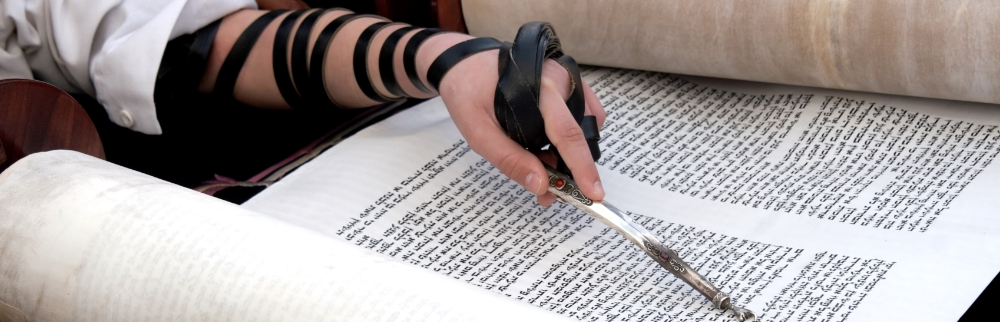
Go, worship the Lord your God! Who are the ones to go? Moses replied, “We will all go, young and old. We will go with our sons and our daughters, our flocks and our herds; for we must observe the Lord’s festival.” (Exod. 10:8-9) Jewish tradition declares that “God, Israel and the Torah are One.” […]
He had a dream; a stairway was set on the ground and its top reached to the sky. (Gen. 28:2)
Jacob’s dream at Bethel is one of the most famous in biblical literature. Although he envisions angels (Hebrew: Malachei Elohim—literally, “messengers of God”), the text makes it clear that they only provide the setting, but that it is God who stands beside him and reiterates the promises made to his grandfather Abraham (Gen. 12:2) and his father, Isaac (Gen. 26:3-4), that his progeny will be prolific and “all the families of the earth shall bless themselves by you and your descendants.”
Were we to compare our patriarchs’ impact on Judaism, Isaac would be a distant third. First place is a tie between his father Abraham, the champion of faith and hospitality, and his son Jacob, the spiritual wrestler. Isaac’s problem lies in how few columns in the Torah are devoted to him. Other than having survived the trauma of the Akedah, the information in parashat Toldot, is basically it. Isaac is best summed up as his father’s son and his son’s father. Like Abraham, Isaac experiences a famine and has his wife taken by a king. Like Jacob, Isaac’s future wife is discovered at a well. Even in Toldot which begins: This is the story of Isaac, son of Abraham. Abraham begot Isaac, the focus shifts in the very next verse to what will develop as Jacob’s story rather than the tale of Isaac.
We are living in an age when the news is filled with demeaning language and accusations of impropriety in the workplace. Whether it is well-known newsmen, movie moguls or politicians, women are treated as objects and worse. Many of the men assume their positions of power will keep them safe and insulated from accusations. While women who speak their mind are threatened, ridiculed and in some cases fired. It does not matter where you live—North America, Israel or Europe –women are fighting for dignity and respect.
Parashat Ki Teitzei contains the most laws of any Torah portion, seventy-four, more than one tenth of all the laws in the Torah, but it is also a good reminder that for the development of the halachah, Biblical law was just a building block. For example, the somewhat confusing law, that one must place a parapet on one’s roof; (Deuteronomy 22:8) not only becomes the basis of the Jewish equivalent to OSHA (Occupational Health and Safety Administration) regulations, but also is used by more contemporary authorities to develop a Jewish legal objection to second hand smoke. (OU Israel, Aliyah-by-Aliyah Parashat Ki Teitzei).
“Let this land be given to your servants as a heritage; do not take us across the Jordan.”(Bamidbar 32,5b). This is what two and a half tribes ask of Moses as the people of Israel are getting ready to cross over the Jordan River and conquer the promised land. Why would they ask to stay on the eastern side of the Jordan valley? They have the explanation in the first phrases of the portion Matot:
Every member of Am Yisrael was once a slave in Egypt. Since we are familiar with the situation of slavery, we have a moral obligation to let our servants go free in the seventh year. In this modern age, who are our slaves? Who or what are we slaves too? What should we let go of?
We often think that e-mails or text messages are like oral conversation; that once the words are pronounced they disappear, but it is not the case. They stay in the minds of people that have been hurt, and the pain is difficult to erase. A little click can cause a great shock: let us take our time, zeman nakat, let us hurry slowly so that we be motsi shem tov – uttering good words, words of good.